How Many Hashtags Should You Use on Instagram in 2026?
Instagram capped hashtags at five. Three big studies disagree on whether more tags help. Here is the number to use and how to test it.

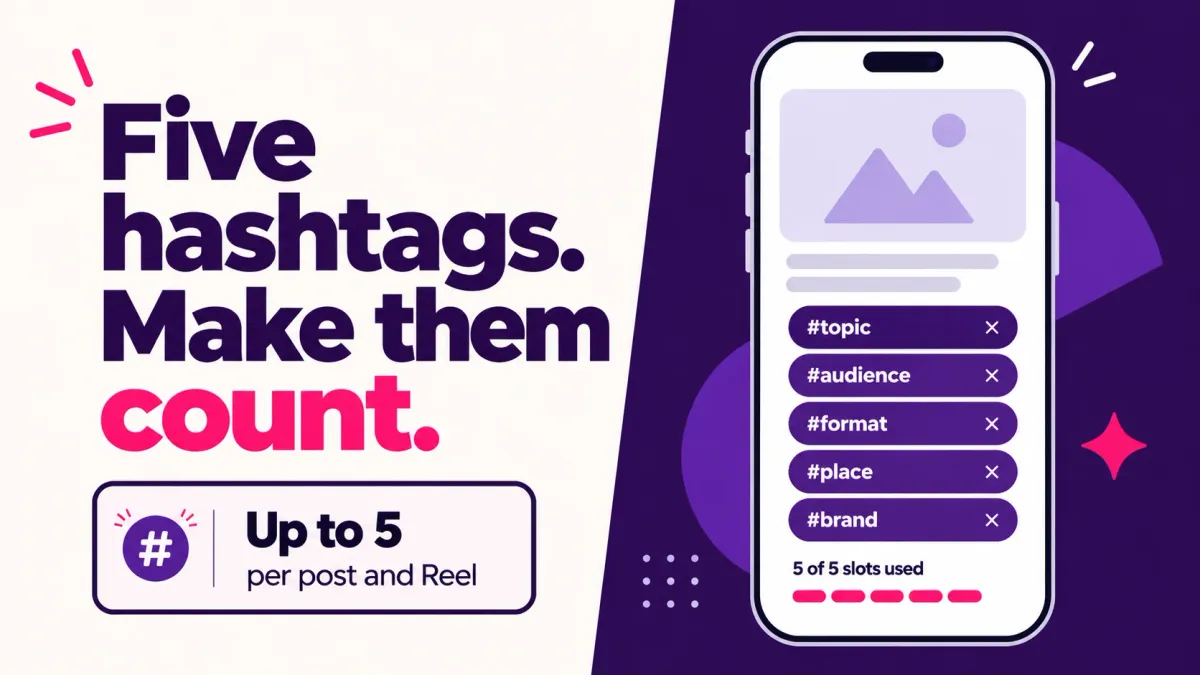
Five. Instagram announced a limit of five hashtags per post and Reel in December 2025, and the two newest large studies we found disagree on whether using all five helps. Use up to five tags that name what is visibly in the post, and treat them as labels, not a reach plan.
Updated: October 2026
TLDR
- Instagram said in December 2025 that it would gradually cap hashtags at five per post and Reel. Its own help page still says 30, so some accounts may still see the older allowance.
- Fanpage Karma's study of 1.6 million posts found the best reach and engagement at four or five hashtags, by margins of a few percent.
- Metricool's study of 24.4 million posts found that posts with at least one hashtag averaged fewer views and interactions than the platform average. That is a correlation, not proof.
- Our rule: three to five specific tags when the post has that much to name, none to two when it does not, and never a pasted block.
Quick answers
- Maximum hashtags? Five per post or Reel, per Instagram's December 2025 announcement, rolling out gradually.
- Extra slots in the first comment? Instagram's statement covers captions. Tool vendors report comment tags share the same five. We found no Instagram page that says so.
- Best number? Four or five if you can name that many things accurately. Fewer is fine for a thin post.
- Do hashtags boost reach? Instagram's head says no. They label the post.
Table of contents
- What is the hashtag limit on Instagram now?
- What do the big studies say about hashtag count?
- Why do the studies disagree?
- What does Instagram say hashtags do?
- How many hashtags should you actually use?
- How do you test your own number?
- Which free tools help with hashtags?
- Frequently asked questions
- Sources
What is the hashtag limit on Instagram now?
On December 18, 2025, Instagram said on Threads that it would gradually cut the number of hashtags allowed in a post or Reel caption to five. Its stated reason was that "fewer (up to 5) more targeted hashtags" can improve performance, as Social Media Today reported. The cap replaced a three-tag test that had been running for about a year.
The word to notice is gradually. When we checked on October 13, 2026, Instagram's help page on hashtags still said you can use up to 30 tags on a post. Later's 2026 hashtag guide calls five a hard limit. Fanpage Karma's data shows 7% of the posts it analyzed carried more than five, so the cap was not universal when that study ran. If your composer still lets you type more, you are probably in the part of the rollout that has not reached you. Plan for five anyway.
The first comment is the other open question. Instagram's announcement talks about the caption. Later's guide says tags in comments count toward the same five, and that Instagram will either block publishing or strip the extras. We could not find Instagram saying either thing on a page we could fetch, so read both as reported, not confirmed. The safe assumption is five total across caption and comments.
What do the big studies say about hashtag count?
Three studies answer the question, and only one of them was run under something like the new rules. Fanpage Karma analyzed 1.6 million posts. Metricool analyzed 24.4 million posts from 375,118 accounts. Later analyzed 18.1 million feed posts in an older study that excluded Reels.
| Study | Sample | Finding on hashtag count | Caveat |
|---|---|---|---|
| Fanpage Karma | 1.6M posts, window not stated, page updated April 22, 2026 | Five tags had the highest reach (+2% against no hashtags). Four had the next best. Engagement was highest at four (+1%) and five (+3%) against zero or one. One to three tags did slightly worse than none, and more than five lost about 3% of reach. | Differences of a few percent. Correlation only. |
| Metricool | 24.4M posts, January and February 2025 against the same months of 2026 | Posts with at least one hashtag averaged 31.70% fewer views and 33.89% fewer interactions than the platform average. | Does not split by count. Published by a tool vendor. Correlation only. |
| Later | 18.1M feed posts, no Reels or Stories, updated June 4, 2025 | Average reach peaked at 20 tags and engagement at 30. | Written when 30 was the limit. Not usable under the cap. |
Read the Later row as history. It found that more was better, up to 30, and that advice ended when the cap arrived. The Fanpage Karma result is the only one that speaks to a five-tag world, and the effect is small. Nobody should rebuild a content plan around +3%.
One pattern in the Fanpage Karma data is worth keeping. A thin set of one to three tags did no better than no tags at all. Fanpage Karma's reading is that a few vague tags do not give the system a clear signal. That fits Instagram's own wording about targeted tags, but it is an interpretation, not a tested cause.
Why do the studies disagree?
They are not measuring the same thing. Fanpage Karma compares posts with different tag counts inside its own sample, scaled by follower count. Metricool compares posts that use hashtags against the platform average across all posts, so its result depends on who adds hashtags in the first place.
Our read, not a finding from either study: accounts that still paste a block on every post may share other habits that lower reach, such as reposted or low-effort content, and a plain comparison cannot separate that from the tags themselves. Neither study is an experiment where one account posts the same thing with and without tags, so treat both as a hint that the count barely matters and the labels do.
What does Instagram say hashtags do?
Adam Mosseri, who runs Instagram, has said this several times. Per Social Media Today's timeline, he said in February 2025 that hashtags do not work as a reach tool, and in May 2025 that they do not improve visibility but do help people see what a post is about and connect related posts. Instagram also ended the option to follow a hashtag at the end of 2024, per Fanpage Karma.
Instagram's creator guidance from 2023 lists relevant keywords in the caption, bio and hashtags as a way to be found in Search. So the working model is metadata. A hashtag helps Instagram file a post under a topic, and the post then travels or does not based on how people react to it. That is why a caption using the words people search can matter more than a fourth tag. Our guides on Instagram SEO and hashtag strategy cover that side.
How many hashtags should you actually use?
Our rule: one tag for each thing you can point to in the post. That could be the topic, the audience it is for, the format, a place if it matters, and a brand tag if you run one. If you can only name two things, use two.
| Situation | Tags | Why |
|---|---|---|
| Reel or carousel with a clear topic and audience | 4 to 5 | Enough distinct things to name, and the bucket where Fanpage Karma saw its best numbers |
| Quote graphic, casual photo, or anything with little to describe | 0 to 2 | Padding mixes signals, and a thin set did no better than none in the same data |
| Campaign with a branded tag | 3 to 4 topic tags plus the brand tag | The brand tag earns a slot only while the campaign runs |
| Your composer still allows 30 | Still 5 or fewer | Instagram says fewer, more targeted tags help, and the cap is coming either way |
Here is a worked example. A freelance designer posts a carousel on raising rates. The five slots could go to #freelancedesigner (audience), #pricingyourwork (topic), #raisingrates (the situation), #carouseltips (format) and the designer's own studio tag (brand). We have not measured these tags. Before using any set, check each tag's post volume in the app and make sure it is not restricted.
The size mix is disputed. Fanpage Karma found that sets mixing large and medium tags did best and suggests two or three large, one or two medium and one niche tag. Our niche hashtag finder sorts tags into small (under 500K posts), mid (500K to 5M) and large (over 5M) tiers and suggests three small, one mid and one large for a five-tag set. Later's guide favors mid-tier tags of 10K to 500K posts. Three sources give three recipes, and none ran an experiment. Pick relevance over size, then test.
How do you test your own number?
Your account is a better dataset than any of the three studies, as long as you keep the comparison clean.
- Pick one format, such as Reels, and one broad topic so the posts are comparable.
- Over three weeks, rotate three versions: five specific tags, two tags, and no tags. Post at similar times of day.
- For every post, log non-follower reach from Insights and the engagement rate. Our free engagement rate calculator does the second one.
- After about twelve posts, compare the median of each group, not the best single post.
- Keep the count that wins by more than the post-to-post swing. If the gaps are inside the noise, use the fewest tags and spend the saved time on the caption.
Twelve posts is a small sample. It tells you about your account and your audience, not about Instagram as a whole.
Which free tools help with hashtags?
ReelDrop is our product, so weigh this section accordingly. Our free hashtag density checker counts the tags in a pasted caption and flags overused tags like love or instagood and tags tied to spam. It also says plainly that no outside tool sees Instagram's real restricted list, so search the tag in the app before you lean on it. The niche hashtag finder covers 15 niches and needs no signup.
Inside the composer, ReelDrop also suggests hashtags matched to the post you are writing. That is a Creator plan feature, $29 a month, and the free tools do not need it. Our roundup of the best Instagram hashtag generators compares other vendors, and our shadowban guide covers a reach drop after a restricted tag. Details on the hashtag generator page.
Frequently asked questions
How many hashtags can you use on Instagram in 2026?
Five per post or Reel, according to Instagram's December 2025 announcement, which said the change would roll out gradually. Instagram's own help page still lists 30, so some accounts may see the old limit for a while. Build your sets around five either way.
Is it better to use 5 hashtags or fewer?
The best evidence we found slightly favors four or five tags, where Fanpage Karma saw its highest engagement. Metricool's data points the other way. The gaps are small and neither study is an experiment. Use as many as you can name accurately, and fewer when the post has little to label.
Do hashtags still work on Instagram?
They work as labels. Instagram head Adam Mosseri has said they do not boost reach, but they tell people and the system what a post is about. A relevant tag can help topic matching and search, and a padded set adds nothing documented. Keywords in your caption do similar work in search.
Should hashtags go in the caption or the first comment?
Either spot can label a post, but tool vendors report that the five-tag limit counts caption and comments together, so the comment no longer gives extra room. Instagram's announcement mentions captions only. Caption placement is simpler, and a few line breaks keep the opening lines clean.
Can you use the same hashtags on every post?
You can, but it works against the point. A frozen block describes your account, so some tags will not match the post in front of you. Instagram says fewer, more targeted tags help. Keep three or four saved sets per topic and choose the five that fit each post.
Do banned hashtags still exist?
Yes. Instagram restricts tags tied to spam or policy violations, and the list changes without notice. No outside tool can see it. Search the tag in the app before you use it, and skip it if recent posts will not load. Our shadowban guide covers what to check if your reach has dropped.
Sources
- Social Media Today: Instagram Implements New Limits on Hashtag Use
- Instagram Help Center: How do I use hashtags?
- Fanpage Karma: How Many Hashtags Should You Use on Instagram?
- Metricool: 2026 Instagram Study
- Later: How Many Hashtags to Use on Instagram (18M Posts)
- Later: Instagram hashtag strategy in 2026
- Instagram for Creators: Tips for Improving Your Reach