Instagram Automation Rules in 2026: What Meta Allows (and What Gets You Flagged)
What Meta allows on Instagram in 2026: API scheduling, comment replies, and DMs in the window. What it flags: follow bots, pods, password tools.

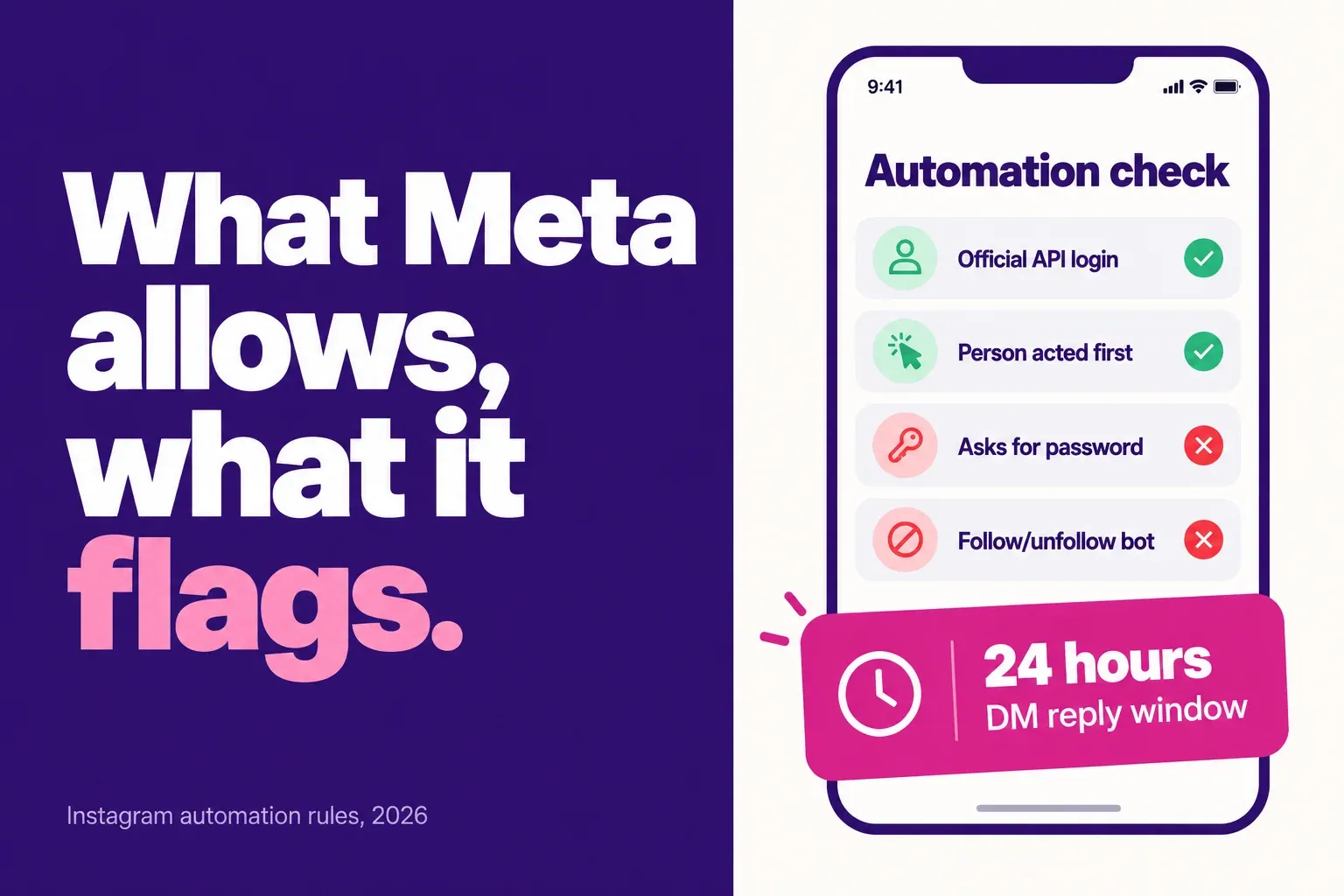
Meta allows Instagram automation that runs through its official API and starts with something a person did: scheduled posts, replies to comments, and DMs sent inside the messaging window. It bans tools that fake activity or ask for your password. What changed since late 2025 is the allowed list, which got longer, not the banned one.
Updated: October 2026
TLDR
- Official API automation is allowed: scheduling (100 posts per 24 hours), comment replies, and DMs.
- DMs need the person to act first. You get 24 hours to reply, or 7 days with a human agent.
- Follow/unfollow bots, auto-likers, scrapers, password tools, and engagement pods are out.
- Meta publishes no numbers for follows or likes. Every figure you see is a community estimate.
Quick answers
- Is Instagram automation allowed? Yes, through the official API and Meta's own tools.
- Can I DM people automatically? Only after they message you or comment, inside Meta's windows.
- Are follow/unfollow bots allowed? No.
- Are engagement pods banned? Meta does not name them, but they trade the fake engagement it bans (our reading).
- Does Meta publish daily limits? For API publishing and messaging calls. Not for likes or follows.
Table of contents
- What does Meta allow you to automate?
- What are the limits on DM and comment automation?
- What does Meta ban outright?
- Are engagement pods against the rules?
- The rulebook at a glance
- How does Meta enforce this?
- Where does ReelDrop fit?
- Frequently asked questions
- Sources
What does Meta allow you to automate?
Three things sit on documented ground. The first is publishing. Meta's Content Publishing guide caps an account at 100 API-published posts in a rolling 24 hours, with a carousel counting as one. The same page still lists 50 in its carousel notes, so Meta contradicts itself. Plan around 100 and stay far below it. Trial Reels have been schedulable through the API since December 2025.
The second is comments. An app can read, reply to, hide, and delete comments on your own media, per the Platform overview. The third is DMs: the same overview says an app can respond to a message within 24 hours.
Meta also ships automation itself. Meta Business Suite has instant reply, away message, keyword replies, and comment to message. We could not open Meta's help center, so this comes from CreatorFlow and Kanal, which quote it. The keyword and comment templates are desktop only, take up to five exact-match keywords, and wait 15 minutes before sending.
The allowed list has grown. Meta added typing and seen indicators in September 2025, multi-image DMs in beta that November, and a link sticker field for story replies in December 2025, which lets an automation react to the link a person tapped. All three are in the platform changelog.
What are the limits on DM and comment automation?
The person has to act first. Meta's messaging guide says conversations begin only when someone messages your account, and your app then has 24 hours to respond. A comment is the other opening, because it lets you send one private reply.
- The window is 24 hours from the person's last message. The Human Agent tag stretches it to 7 days, but Meta describes it as support for a real person who needs more time, not a way to keep a bot talking.
- Private replies are one per comment, sent within 7 days, per the Spur guide summarizing Meta's rules. Meta's own page returned an error when we rechecked. Follow-ups work only if the person replies.
- Meta's overview sets 750 private-reply calls per hour per account for post and reel comments, and 100 calls per second for text messages.
- Text messages top out at 1,000 bytes, and group messaging is not supported. People who do not follow you land in the Requests folder.
- Where the law requires it, an automated chat must say it is automated. Meta names California and Germany and recommends doing it everywhere.
What does Meta ban outright?
Instagram's November 2018 announcement says apps that generate inauthentic likes, follows, and comments violate its Community Guidelines and Terms of Use. That covers auto-likers, auto-commenters, and mass follow and unfollow bots. It does not matter whether the tool calls itself a growth assistant.
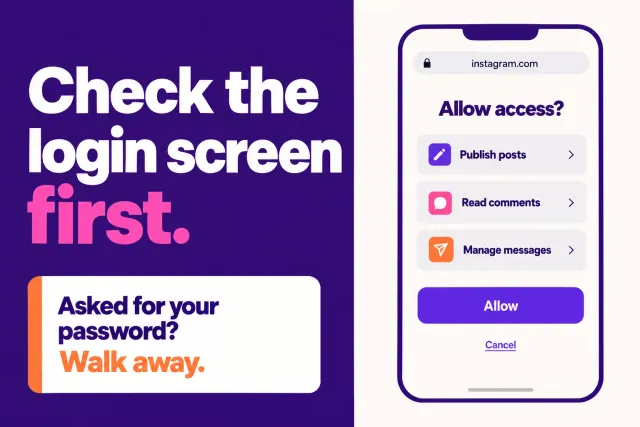
Password tools are the second category. The same announcement notes that these apps work because people share their username and password. Meta's Platform Terms, updated February 3, 2026, tell developers they must not separately request or collect a Meta user's login credentials. A tool that asks for your password is outside the rules before it sends anything. Our scheduling apps safety post explains how that plays out.
Scraping is the third. Instagram's help page on data scraping says data scraping goes against its Terms of Use. Cold mass DMs fall out of the rules too, since the API requires the person to message first. A blast tool has to work off the API. That last point is our inference, but it follows from the messaging guide. Our bots post covers the fallout.
Are engagement pods against the rules?
Meta does not name pods on any page we could read. Its Community Guidelines page blocks automated fetching, so we relied on secondary sources. In 2018 Facebook removed ten groups used to organize pods, and Instagram told BuzzFeed News they violated its terms, per PetaPixel's summary. PostEverywhere adds that Instagram does not name pods but bars artificially collecting likes, followers, and shares.
Our reading: a pod does by hand what the 2018 announcement bans apps for. A fixed group trades likes and comments to look popular. Meta publishes no penalty schedule for pods, so the real risks are detection and analytics that no longer describe your actual audience.
The rulebook at a glance
| What you automate | Verdict | Basis |
|---|---|---|
| Scheduling posts, reels, carousels through the API | Allowed | Official: Content Publishing, 100 per 24 hours |
| Scheduling Trial Reels through the API | Allowed | Official: changelog, December 2025 |
| Replying to comments through the API | Allowed | Official: Platform overview |
| Comment-to-DM, one private reply per comment | Allowed | Official docs, via secondary summary |
| Auto-replying to DMs inside 24 hours | Allowed | Official: messaging guide |
| Bot follow-ups after the window closes | Not allowed | Human Agent tag is for people |
| Cold DMs to people who never engaged | Not possible via API | Official: person must message first |
| Meta Business Suite keyword and comment replies | Allowed | Meta's own tool, via secondary quotes |
| Auto-follow, unfollow, like, or comment | Banned | Instagram, November 2018 |
| Tools that ask for your password | Banned for developers | Meta Platform Terms |
| Scraping | Banned | Instagram help page |
| Engagement pods | Not named, treat as banned | Our reading |
A quick test for anything not on the list. Did the person act first? Does login happen on instagram.com, never in the tool? Would a human plausibly do this at this pace? Two no answers means walk away.
How does Meta enforce this?
Meta's 2018 announcement describes the response: removal of the fake activity, an in-app message, a prompt to change your password, and a warning that continued use may affect your Instagram experience. The 2020 authenticity announcement lists signs of automation as one trigger for asking an account to confirm who is behind it. Declining can mean reduced distribution or a disabled account.
What Meta does not publish is a schedule for follows, likes, or comments. Guides like Metricool's circulate numbers, such as roughly 150 follow actions a day, and they call them recommendations. Treat them as folklore. Speed and sameness are what stand out: identical text, instant replies at huge volume, a login from a data center. Those last signals are our inference. If you hit a block, see our suspension guide, check reach with the shadowban checker, and read why accounts get banned on our learn page.
Where does ReelDrop fit?
ReelDrop is our product, so weigh this accordingly. It is a Meta Tech Provider that publishes and sends DMs through the official API, and it never asks for your Instagram password. Its engine caps the follow-up timer at 23 hours so it lands before the 24-hour window closes, rotates reply variants, and lets you cap public replies per post. It sets no DM cap of its own, since Meta applies its own limits. Details are on the DM limits docs page and safety page. The comment-to-DM feature page explains the trigger.
It is Instagram-only and a younger product than the big schedulers. And an official API does not make a bad flow good. One identical message sent a thousand times still looks like spam.
Frequently asked questions
Is Instagram automation allowed in 2026?
Yes, when it runs through Meta's official API or Meta's own tools and starts with something a person did. Scheduling, comment replies, and DM replies inside the messaging window are documented. Follow/unfollow bots, auto-likers, scrapers, and password-based tools are not. Meta publishes no approved brand list, so check how a tool logs in.
Can I send DMs to people automatically on Instagram?
Only to people who contacted you. A DM or story reply opens a 24-hour window, and a comment lets you send one private reply within 7 days. Cold messages to people who never engaged are not possible through the API, and tools that claim otherwise work outside it.
How many follows, likes, or DMs can I automate per day?
Meta publishes no daily number for follows, likes, or comments, so any figure you see is a community estimate. It does publish API limits: 100 API-published posts per 24 hours, and 750 private-reply calls per hour for comments on posts and reels. Most creators stay far below both.
Are engagement pods against Instagram's rules?
Meta does not name pods on any page we could read. Its 2018 announcement bans apps that generate inauthentic likes and comments, and a pod trades the same signals by hand. We read pods as breaking the spirit of those rules, though Meta publishes no specific penalty for them.
Will Instagram ban me for using a scheduler?
We found no Meta statement penalizing publishing through the official API. The risk sits with tools that ask for your Instagram password or log in from a browser, because Meta's rules tell developers not to collect credentials. Connect through Instagram's own login screen and you can revoke access from your settings.
What is the difference between a bot and allowed automation?
Allowed automation uses permissions you granted through Meta's login, answers people who acted first, and stays inside the messaging window. A bot imitates a human on your account, often with your password, and acts on strangers. Meta's 2018 announcement says the second kind violates its Community Guidelines and Terms of Use.
Sources
- Meta: Content Publishing
- Meta: Instagram messaging guide
- Meta: Instagram Platform overview
- Meta: Instagram Platform changelog
- Meta: Platform Terms
- Instagram: Removing fake likes, follows and comments (2018)
- Instagram: New authenticity measures (2020)
- Instagram Help: data scraping restrictions
- CreatorFlow: Instagram built-in automation
- Kanal: Instagram automatic messages
- Spur: Instagram auto reply to comments
- PetaPixel: Facebook removes pod groups
- BuzzFeed News: Facebook removes ten algorithm-gaming groups
- PostEverywhere: engagement groups
- Metricool: Instagram limits
- Instagram bots in 2026
- Are Instagram scheduling apps safe?
- Instagram account suspended
- Is ReelDrop safe?