Instagram Bots in 2026: Why They Kill Your Reach (and What to Use Instead)
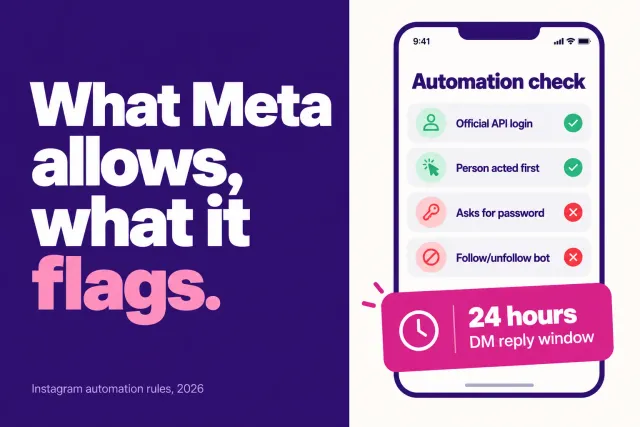
Growth bots break Meta's rules and hurt engagement. Official-API automation is the safe path. Here is what Meta allows in 2026.

Instagram's average engagement rate is 0.48%, so every bot follower you add makes your account look weaker, and bots that like, follow, or message for you break Meta's rules. Growth bots are not safe. Automation built on Meta's official API, like scheduling and comment-to-DM replies, is.
Updated: October 2026
TLDR
- Bots that automate likes, follows, comments, or cold DMs, and services that sell followers, break Instagram's rules.
- Meta has removed fake activity from accounts that use them since 2018, and it can ask an account to verify identity when it sees signs of automation.
- Meta has not published a reach penalty or exact action limits. The damage you can measure is the engagement-rate math and the periodic cleanups.
- Automation that runs through Instagram's official API is the safe side: scheduling, one private reply per comment, auto replies inside the 24-hour window.
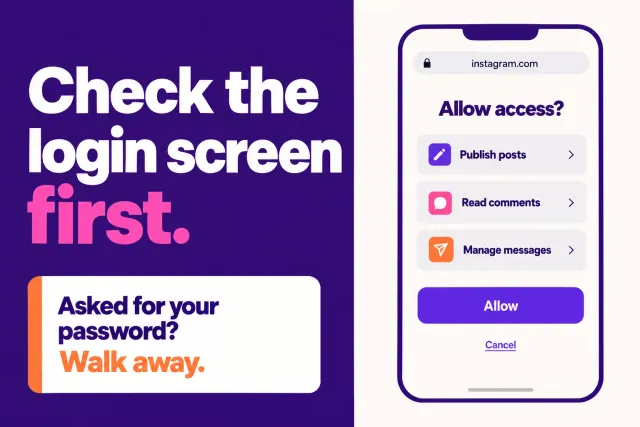
- If a tool asks for your Instagram password, do not connect it.
Quick answers
- Are Instagram bots against the rules? Yes, for tools that fake likes, follows, and comments or that scrape. Meta said so in 2018 and has not changed its position.
- Can a bot get you banned? It can lead to removed activity, reduced distribution, or a disabled account. Meta publishes no exact thresholds.
- Do bots hurt reach? They hurt your engagement rate for certain. A direct reach penalty is plausible but unconfirmed by Meta.
- Is comment-to-DM a bot? It is automation, and it is allowed when it runs through Meta's messaging API with one reply per comment.
- What is the safe alternative? Official-API tools for scheduling and DM replies, plus a few minutes a day of real replies.
Table of contents
- What counts as an Instagram bot?
- What does Meta say about bots?
- Do bots really hurt your reach?
- What happened in the May 2026 purge?
- Why are password tools the riskiest?
- What should you use instead of a bot?
- Where ReelDrop fits
- Frequently asked questions
- Sources
What counts as an Instagram bot?
People use the word for five different things, and Meta treats them very differently. The useful split is whether the tool fakes demand or helps you run your account through channels Meta built for that.
| Type | What it does | Where it stands with Meta |
|---|---|---|
| Bought followers, likes, pods | Adds engagement from accounts that did not choose to give it | Against the Community Guidelines as artificial engagement |
| Follow, unfollow, auto-like, auto-comment tools | Acts on Instagram as you, at volume | Meta says apps that generate inauthentic likes, follows, and comments violate its Terms and Guidelines |
| Scrapers and mass cold-DM tools | Pulls profile data or messages strangers in bulk | Scraping is a Terms violation per Instagram's help center |
| Password-login "automation" | Logs in to your account with your credentials | The mechanism Meta's 2018 crackdown targeted |
| Official-API automation | Publishes posts, replies to comments, answers DMs through Meta's endpoints | Allowed, inside Meta's messaging and publishing rules |
The first four rows share a pattern. They create activity a real person did not choose to give you, or they act as you through a login Meta never approved. The fifth row is ordinary software calling documented endpoints.
What does Meta say about bots?
In November 2018, Instagram announced it would start removing inauthentic likes, follows, and comments from accounts that use third party apps to boost their popularity. It called those apps a violation of its Community Guidelines and Terms of Use, told affected accounts to change their passwords, and warned that accounts that kept going might see their experience affected.
In August 2020, Instagram said it would ask some accounts to confirm who is behind them when it saw coordinated inauthentic behavior, a follower base mostly in another country, or signs of automation such as bot accounts. An account that declines may get reduced distribution or be disabled. Meta says ID copies are deleted within 30 days of the review.
On scraping, Instagram's help center says data scraping goes against its Terms of Use and can get an account restricted. Our guide to why Instagram accounts get banned covers the other common triggers.
What Meta has not done is publish follow, like, or DM limits, or a reach penalty for bots. The hourly numbers you see on vendor blogs are community estimates. Treat any exact limit as a guess.
Do bots really hurt your reach?
Nobody outside Meta can give you a percentage, because Meta has never published one. Two effects are measurable anyway.
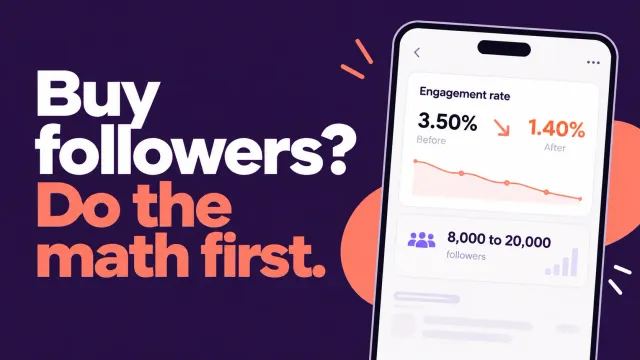
The first is engagement math. Socialinsider's benchmark covers 35 million posts from 447,613 profiles (full-year 2025 data) and puts the average engagement rate at 0.48%, down 24% year over year. Its formula is likes plus comments divided by followers. A follower who never engages still counts in the denominator.
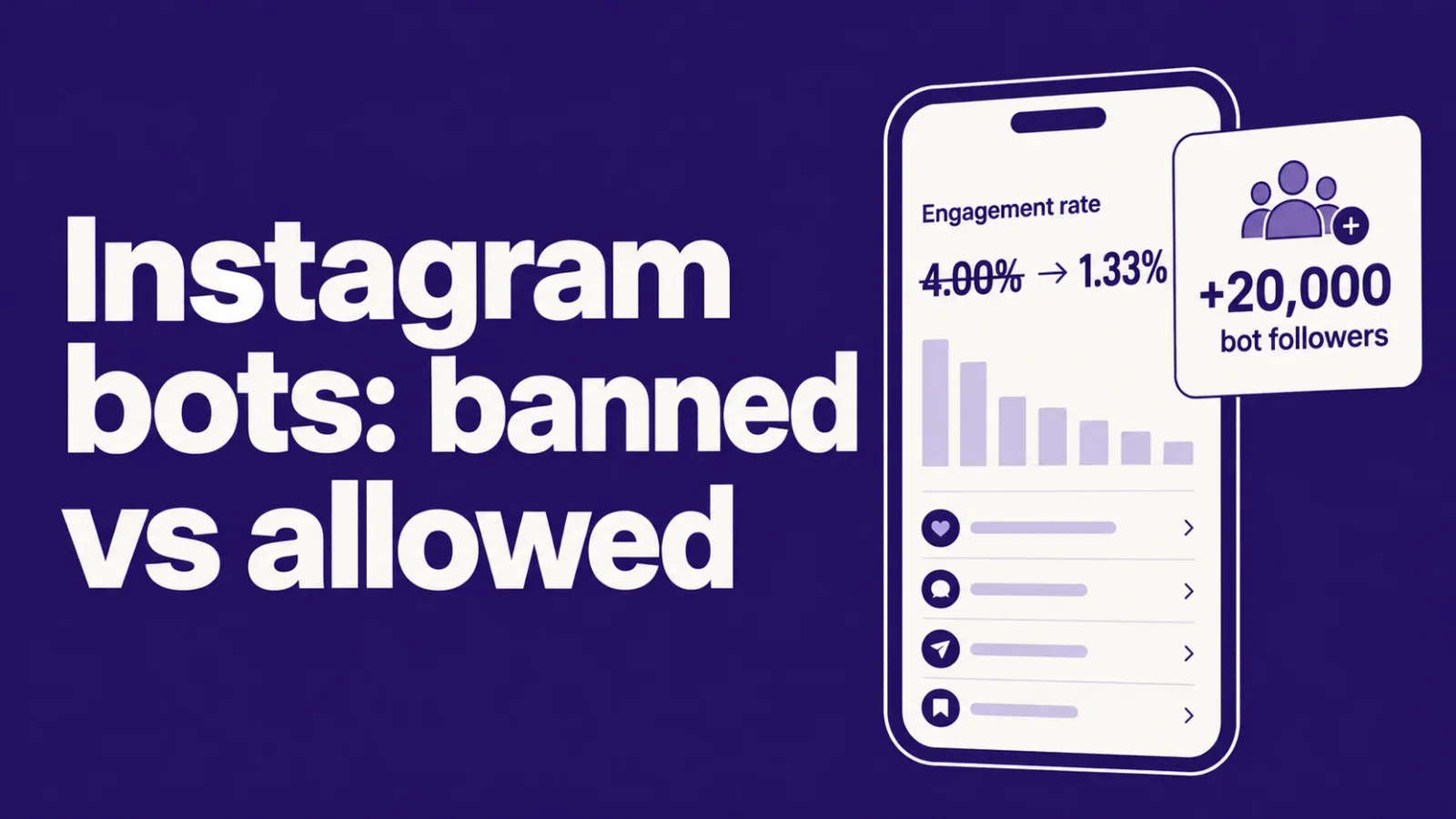
Here is a worked example with made-up round numbers. An account has 10,000 real followers and averages 400 likes and comments per post.
| Scenario | Followers | Engagement per post | Engagement rate |
|---|---|---|---|
| Real audience only | 10,000 | 400 | 4.00% |
| Plus 5,000 bot followers | 15,000 | 400 | 2.67% |
| Plus 20,000 bot followers | 30,000 | 400 | 1.33% |
Nothing about the content changed, yet the account now looks like it has a content problem. Sponsors and brands read that rate. You can run your own numbers in our free engagement rate calculator.
The second effect is ranking. A secondary compilation of Adam Mosseri's statements lists watch time, sends per reach, likes per reach, and two-way conversations among the signals Instagram uses. Fake followers do not watch, send, or reply, so padding your audience can pull those per-reach rates down. That is our inference, not a Meta statement.
What happened in the May 2026 purge?
On May 6 and 7, 2026, accounts of every size, celebrities included, watched their follower counts drop overnight. People called it the Great Purge of 2026. Per PiunikaWeb's report, a Meta spokesperson said the drops came from a routine process to remove inactive accounts, that active followers were unaffected, and that restored accounts would be counted again after verification.
Many outlets, including IANS, described it as a bot cleanup. Meta's own wording was about inactive accounts, so how many bots were in the sweep is unconfirmed. Reported losses for the biggest accounts ranged from about 5 million to over 14 million depending on the outlet.
The lesson holds either way. Follower counts live on Meta's side, and followers you bought or never earned can vanish without notice. Meta also says about 4% of its more than 3 billion monthly users are fake accounts, according to Social Media Today's Dec 2025 coverage of its enforcement report. That figure covers all Meta apps, not Instagram alone.
Why are password tools the riskiest?
Meta's 2018 notice pointed at the mechanism, not just the behavior. People who use these apps share a username and password, and the apps sometimes use those accounts to produce fake likes, follows, and comments. Instagram said that also makes the accounts less secure.
So the check is simple. A tool that connects through Meta's own login on instagram.com, and asks for permission scopes you can review and revoke, is working the approved way. A tool that wants your password in its own form is not. If you have ever handed one over, change the password. Meta gave that same advice in 2018. Our safety page has a four-step way to check any tool yourself.
What should you use instead of a bot?
Meta does support automation, on its own terms. Its private replies documentation lets an app send one message to a person who commented, within 7 days. It lands in the inbox if they follow you and in the Request folder if they do not. A follow-up is allowed only if the person answers, and it has to go out within 24 hours of that answer.
Meta's messaging policy sets the same 24-hour window for automated replies and lets a human agent respond for up to 7 days. Meta Business Suite also ships its own automated responses, including a comment-to-message option with a few keywords. Check Meta's help center for current limits before you rely on it.
In practice that means:
- Schedule posts through a tool that publishes via the official API. We cover the safety question in are Instagram scheduling apps safe.
- Run comment-to-DM through an official messaging integration. Is ManyChat safe walks through one of the most used options and its caveats.
- Reply to comments yourself for a few minutes a day. No tool replaces that.
- Pick from tools that use only official access in our safest Instagram tools list.
Official does not mean immune. Identical replies at high volume still look like spam, so vary the wording and keep volume sensible.
Where ReelDrop fits
ReelDrop is our product, so weigh this accordingly. It schedules posts and runs comment-to-DM automations through Instagram's official API, and it is a Meta Tech Provider, a narrower program than Meta's Business Partner directory. It has no follow, unfollow, auto-like, or auto-comment features, and it works on Instagram only. The free Starter plan includes 5 active DM automations, per the pricing page.
Frequently asked questions
Will Instagram ban me for using a bot?
It can. Meta has said it removes fake activity from accounts that use growth apps and may affect those accounts' experience. It can also ask for identity confirmation when it sees signs of automation. Meta publishes no exact thresholds, so the safest course is to avoid follow, like, and comment bots entirely.
Is comment-to-DM automation a bot?
It is automation, but a different kind from growth bots. Through Meta's messaging API, a tool can send one private reply per comment within 7 days, and follow up only if the person responds. Tools that stay inside those rules are working the way Meta documents.
Do Instagram bots actually work for growth?
Not in a way that lasts. Bought or botted followers do not watch, save, or reply, so your engagement rate falls as the count rises. Meta also removes fake activity, and cleanups like the May 2026 one can erase padded counts overnight.
How can I tell if my followers are bots?
Look for sudden follower jumps with no matching rise in likes or comments, and for profiles with no posts or random usernames. Then calculate your engagement rate. If it sits far below the typical range for your size, padded followers are a likely cause, though a content mismatch can look the same.
What should I do if I already used a bot service?
Stop using it and change your Instagram password, which cuts off any app that holds your login. Meta gave that advice in 2018 for exactly this case. Then check Account Status in Instagram's settings for restrictions, and avoid reconnecting any tool that asks for your password.
Are scheduling apps bots too?
Not in the sense Meta enforces against. Scheduling through the official publishing API creates posts you wrote, not fake engagement. The risk lies in tools that log in with your password. Our scheduling safety guide covers how to tell the two apart.
Sources
- Instagram: Reducing Inauthentic Activity on Instagram (Nov 2018)
- Instagram: Introducing New Authenticity Measures (Aug 2020)
- Instagram Help Center: why your account was restricted for data scraping
- Meta for Developers: Send a private reply to a commenter
- Meta for Developers: Messenger Platform and Instagram messaging policy
- Socialinsider: 2026 Instagram Organic Engagement Benchmarks
- Social Media Today: Meta Outlines Latest Data on Content Removals and Fake Accounts
- PiunikaWeb: Instagram follower drop and Meta's statement (May 2026)
- IANS via Punjab Kesari: Great purge of 2026
- Dataslayer: Instagram algorithm 2026 ranking signals (secondary compilation)
- Social Media Examiner: Meta Business Suite features