How Often Should You Post on Instagram in 2026? (What the Data Says)
Three to five feed posts a week fits most solo creators. See where Buffer and Dash Social disagree, and pick a schedule.

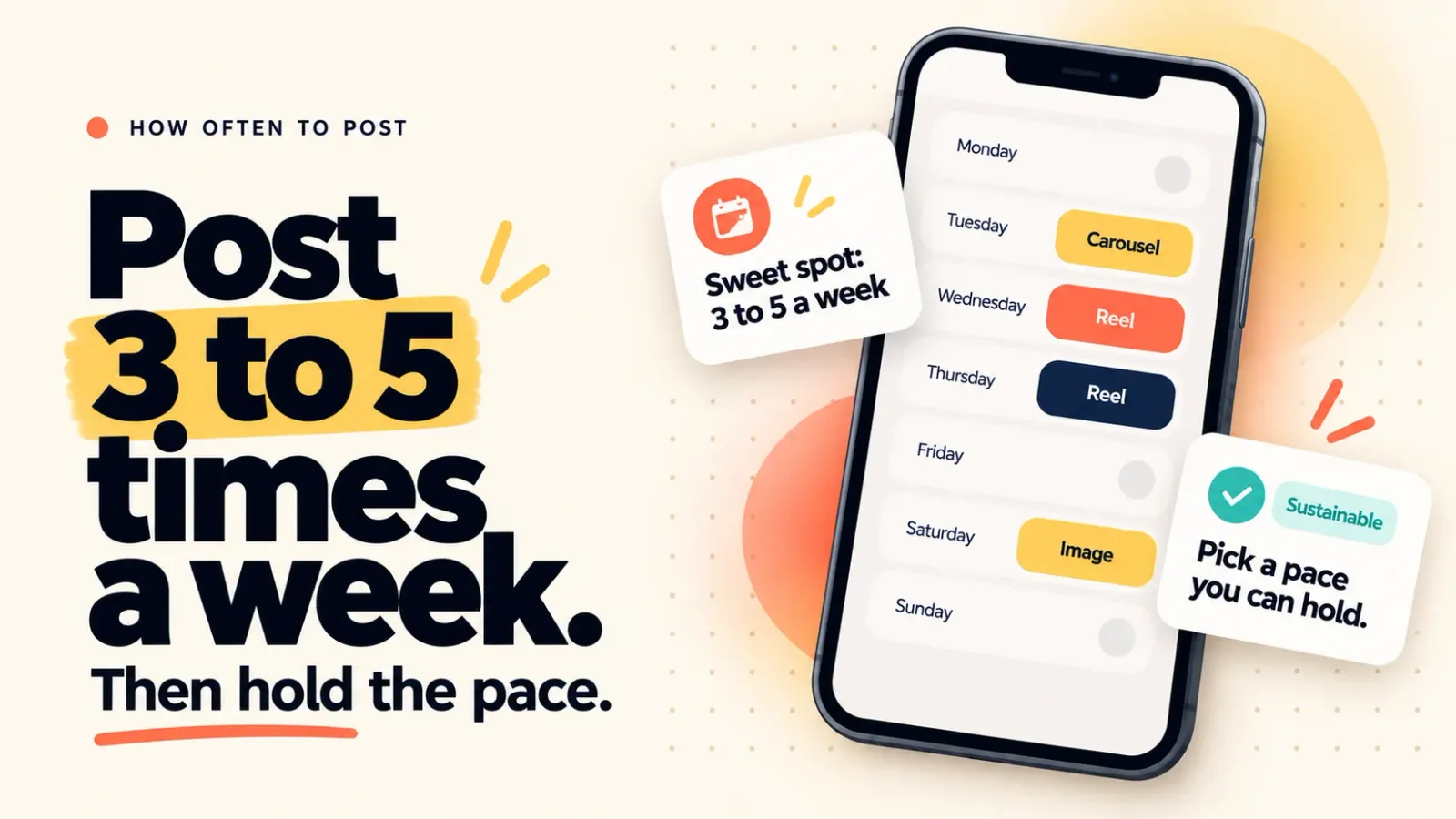
How often should you post on Instagram? For most solo creators, three to five feed posts a week is the best-supported answer. Buffer's data ties more posting to more reach and growth, Dash Social finds engagement rate peaks at two to three, and Instagram's guidance names no number. Choose the pace you can hold for months.
Updated: October 2026
TLDR
- Three to five feed posts a week is the range with the most support, and Buffer's 2.1 million posts call it the sweet spot for growth without burnout.
- In Buffer's data, more posting meant more reach and followers, with smaller gains after five a week. Dash Social's brand data found engagement rate highest at two to three.
- Instagram publishes no official number. Adam Mosseri has said, per a RouteNote write-up, that posting often helps reach and burnout is the risk.
- The floor is one or two posts a week. Weeks with no posts were the clear loser.
- Match the number to your weekly hours, then test it for four weeks.
Quick answers
- Best frequency for most creators: three to five feed posts a week.
- Minimum to stay active: one or two posts a week.
- Is daily too much? Not by the data, if quality holds. It is mostly an hours question.
- Reels per week: one to three had the highest engagement in Dash Social's brand data.
- Stories: a separate layer that serves your existing followers.
Table of contents
- What do the big studies say?
- Why do the studies disagree?
- How much does each extra post buy?
- What about Reels and Stories?
- What does a week look like at 3, 5 and 10 hours?
- How do you test your own number?
- What happens if you stop posting?
- Where does ReelDrop fit?
- Frequently asked questions
- Sources
What do the big studies say?
Three datasets get quoted most. We read all three in October 2026, and they do not say the same thing.
| Study | Sample and window | What it measured | Finding | Caveat |
|---|---|---|---|---|
| Buffer | 2.1M feed posts, 102K accounts, published Aug 2025 | Follower growth and reach, each account against its own history | More posts, more growth. 3 to 5 a week is the sweet spot | No Stories. Photos, Reels and carousels pooled |
| Dash Social | 3.3M posts from 3,000+ brands, Jul 2025 to Jun 2026 | Average engagement rate (completion rate for Stories) | 2 to 3 feed posts a week highest | Brand accounts on one vendor's platform |
| SocialPilot | 4.4M posts, 45,700 accounts | Engagement change by frequency | "No magical number." Suggests 3 to 5 a week | Chart only, no method detail on the page |
Instagram itself does not help here. Its creator guidance on improving reach lists ranking signals and tips but gives no posting cadence. Adam Mosseri did take the question in a December 2024 Reel. RouteNote's write-up says he told creators there is no single answer, that some successful accounts post once a month and others five Reels a day, that posting often generally helps reach, and that burnout is the thing to avoid. We could not open the Reel, so treat that as a secondhand summary.
Why do the studies disagree?
Because they measure different things. Buffer compared each account with its own earlier weeks, so a fast-growing account does not make the high-frequency buckets look better than they are. Its numbers still show correlation, not proof that posting more caused the growth. Buffer also sells a scheduler, as do we, so weigh the framing accordingly.
Dash Social looked at average engagement rate across brand accounts. A rate is a ratio, and our read, which neither study proves, is that extra posts can add reach while each individual post's rate slips. Both findings can be true. More posting can grow total reach and followers while a middle cadence gives the best rate per post.
The softness of these numbers shows up inside Dash Social's own work. Its December 2025 edition said to post Reels two to three times a week. The August 2026 edition says one to three. Both ranges meet at three posts a week, and that is the number we would start from.
How much does each extra post buy?
Buffer's fixed-effects model gives follower growth rate lifts for each bucket, measured against weeks with no posts. Buffer's own worked example uses a 5,000-follower account. We extended it one step, to followers gained per extra post, using the fewest posts that put you in each bucket (1, 3, 6 and 10).
| Posts per week (bucket minimum) | Growth rate lift | Extra followers per week at 5,000 | Added followers per added post |
|---|---|---|---|
| 1 (bucket: 1 to 2) | 0.12% | 6 | n/a |
| 3 (bucket: 3 to 5) | 0.26% | 13 | 3.5 |
| 6 (bucket: 6 to 9) | 0.44% | 22 | 3.0 |
| 10 (bucket: 10 or more) | 0.66% | 33 | 2.75 |
The arithmetic is ours and the bucket minimums are an assumption, so treat the decimals loosely. The shape is what matters. Each added post still pays at ten a week, just a little less than at three. Buffer also found reach per post rose about 12 percent at three to five posts a week compared with one to two, then roughly 6 and 5 points more at the next two steps.
So why not post ten times a week? Because the gain per post is the small part of the bill. Buffer itself warns that volume that forces lower quality, or ends in burnout, can cost more growth than a measured pace would.
What about Reels and Stories?
Buffer pooled photos, Reels and carousels and left Stories out. Dash Social split formats and found one to three Reels a week had the highest engagement. It found Stories behave differently: brands posting 30 or more a week, where every frame counts, had the best completion rates. Both sources say Stories mostly serve people who already follow you.
One SocialPilot guide recommends five to seven Reels a week. We found no data beside that figure. For context on what brands actually do, Dash Social's industry table shows beauty, food and beverage, and wellness accounts averaging about five feed posts a week. For how Reels get ranked once posted, see our Reels algorithm guide.
What does a week look like at 3, 5 and 10 hours?
Pick a cadence from your hours, not from a chart. ReelDrop's free content frequency planner works this way: about three hours a week supports about three posts, and ten or more hours supports eight to twelve. The three templates below follow that logic. They are our suggestions, not tested results. They lean on Tuesday to Thursday because Buffer and Sprout Social both found midweek strongest and weekends weakest. Check your own best times before locking them in.
| Weekly hours | Feed posts | Sample week | Stories |
|---|---|---|---|
| About 3 | 3 | Tue carousel, Wed Reel, Thu Reel or single image | A few frames on posting days |
| About 5 | 4 or 5 | Mon carousel, Wed Reel, Thu Reel, Sat single image, optional Sun Reel | One short sequence most days |
| About 10 | 8 | Mon Reel and single image, Tue carousel, Wed Reel, Thu carousel, Fri Reel, Sat single image, Sun Reel | A sequence every day |
Batch the filming. Four Reels shot in one sitting cost far less than four separate sessions. Assign each slot a topic with content pillars so the week plans itself, and queue it all in one go with a scheduler. Our scheduler roundup compares ten.
How do you test your own number?
Studies describe averages. Your account is one account. Here is a four-week test we would run, a method and not a result.
- Weeks 1 and 2: post at your current cadence and note reach per post, the share of reach from non-followers, and net followers.
- Weeks 3 and 4: add two posts a week in the same formats and note the same three numbers.
- Compare reach per post first. If it holds or rises, the extra posts are paying for themselves.
- Check your engagement rate with the free calculator. A falling rate with rising reach is the pattern Dash Social's numbers hint at.
- Keep the higher cadence only if you still enjoy it in week four. Repeat the test once, since four weeks is noisy.
Instagram's insights split accounts reached into followers and non-followers, which is the number to watch if growth is the goal.
What happens if you stop posting?
This is the clearest result in the data. In Buffer's analysis, weeks with no posts had growth about 0.08 standard deviations below an account's usual, which Buffer calls the no-post penalty. Even one or two posts a week beat that. If life gets busy, cut frequency and keep the rhythm. Posting daily for two weeks and then vanishing for a month is the pattern to avoid.
Where does ReelDrop fit?
ReelDrop is our product, so weigh this accordingly. The planner above is free, needs no signup, and is an hours-based heuristic, not a study. If you want to queue a week at once, ReelDrop's Starter plan is free for one Instagram account, with unlimited scheduling and posting and a calendar with week and month views. Details are on the scheduler page. If you plan to post a lot of tagged content, our hashtag guide covers the current five-tag limit.
Frequently asked questions
Is posting every day on Instagram too much?
Not by the data. Buffer's analysis found growth and reach kept rising up to ten or more posts a week, though each extra post added less. The real limit is quality and burnout. If daily posting means rushed work or quitting after three weeks, three to five posts will beat it.
How often should a beginner post?
Start at three feed posts a week if you can hold it, and two if you can't. Buffer calls one to two posts a week the minimum to stay active. We found no beginner-specific study, so treat the number as a starting rhythm and adjust after a month of your own data.
How many Reels should I post a week?
Dash Social's analysis of more than 700,000 Reels found brands posting one to three a week had the highest engagement rates. Buffer did not split Reels from other formats. Some guides push five to seven Reels weekly but cite no data for it. Start with one or two, mixed with carousels.
Do Instagram Stories count toward posting frequency?
Treat them as a separate layer. Buffer left Stories out because they mostly reach existing followers, not new people. Dash Social found brands posting 30 or more Stories a week, counting each frame, had the highest completion rates. For a solo creator, a short sequence on posting days is a realistic start.
Does posting less often hurt my reach?
Not posting at all costs the most. In Buffer's data, weeks with zero posts landed below an account's typical growth, while even one or two posts a week beat that. Reach per post also rose about 12 percent when accounts moved from one or two posts a week to three to five.
Is quality more important than posting frequency?
Buffer's own data scientist said content quality probably matters most, and Dash Social says the same about Stories. Frequency is a lever you pull once the content works. Pumping out weak posts is unlikely to produce the gains the studies show, and it makes burnout more likely.
Sources
- Buffer: How Often Should You Post on Instagram in 2026?
- Dash Social: How Often Should You Post on Instagram in 2026?
- SocialPilot: How Often Should You Post on Instagram in 2026?
- RouteNote: How often you should post on Instagram, according to Instagram
- Instagram for Creators: Tips for improving your reach
- Buffer: Best Time to Post on Instagram, 9.6M posts
- Sprout Social: Best Times to Post on Instagram in 2026
- Content frequency planner, Best time to post finder, Instagram content pillars, Instagram scheduler.