Instagram Long-Form Video: What Creators Should Do Now
Instagram is testing 90-minute horizontal videos called Features. Here is who can post, how linked Reels work, and what to do before access.

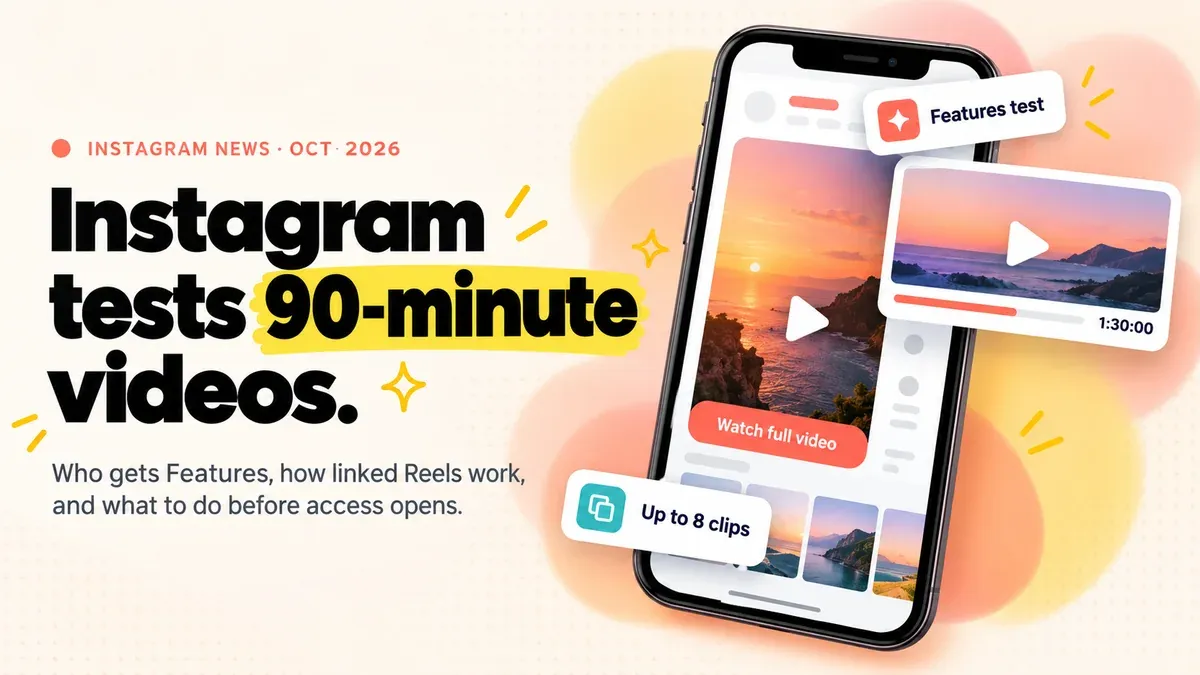
Instagram Features is a test, not a launch. Announced October 26, 2026, it lets selected creators upload horizontal videos of up to 90 minutes, with short Reels linking to the full video. Access is limited to Brazil and a small US group, and Instagram has announced no ad revenue share.
Updated: October 2026
TLDR
- Features are horizontal videos, up to 90 minutes in testing, built for podcasts, interviews, comedy sets and vlogs.
- Only invited creators in Brazil and a small US group can post them. There are no public eligibility rules and no rollout date.
- Linked Reels let up to eight short clips point to one full video, so the Reel works as the trailer.
- There is no revenue share, though existing sponsorships carry over. YouTube's 55% ad share is the number to beat.
- If you are not in the test, the useful move today is preparing clips, not moving your show.
Quick answers
- What is it called? Features. Search "Instagram Features long-form video" to avoid generic feature news.
- How long can a video be? Up to 90 minutes in testing, one of several limits Instagram is trying.
- Who can post one? Selected creators in Brazil and a small US test group.
- Does it pay? No revenue share. Existing sponsorships carry over.
- Can a scheduler publish it? Unconfirmed. We found no Meta documentation for API publishing of Features.
Table of contents
- What is Instagram Features?
- Who can post a Feature right now?
- How do linked Reels work?
- Will Instagram pay for long-form video?
- How is this different from IGTV?
- Can you schedule Features with a tool?
- How should you prepare your clips now?
- Should you move your show to Instagram?
- Where ReelDrop fits
- Frequently asked questions
- Sources
What is Instagram Features?
On Monday, October 26, 2026, Instagram head Adam Mosseri and product VP Tessa Lyons announced a test of long videos called Features, in a roughly six-minute video posted to Instagram. A Feature is a horizontal video aimed at the things that never fit in a Reel: full podcast episodes, interviews, comedy sets and vlogs, according to Online Tech Tips.
The 90-minute figure shows up in nearly every report, but Variety describes it as one of several length limits Instagram is testing. Treat it as a ceiling in testing, not a final spec.
Mosseri spent years arguing against this, on the grounds that short clips drive more shares and DMs. Lyons pushed for the change. His new line is that short and long video can help each other, which is a polite way of saying the Reel becomes the trailer (TechCrunch).
Who can post a Feature right now?
Very few people. Instagram tried Features with creators in Brazil first and is now expanding to a small US test. Metricool's write-up says Instagram plans to widen the US group to tens of thousands of creators, with no date for a general release. Instagram has not published eligibility rules, and the reporting we reviewed describes no way to apply.
Online Tech Tips notes Instagram may switch the test on server-side, so updating the app will not unlock it. If you see nothing new, nothing is broken. You are not in the test. The gating looks regional too: 9to5Google found the announcement video could not be watched outside the US.
How do linked Reels work?
This is the part we find most interesting. A creator links a Reel to a Feature, and a viewer who likes the clip taps through to the full video without leaving the app. Variety reports that up to eight clips can point to one long video. TechCrunch calls the idea Clips as Reels, and other outlets say linked Reels.
Today a podcaster posts a clip, says "full episode on YouTube, link in bio," and leaks viewers at every step of that trip. Linked Reels try to close the gap. On Explore, GSMArena reports the longer videos first appear as short clips with a "Watch full video" button.
One detail worth knowing: a Feature reportedly stops playing when you leave the app, though Mosseri said that could change, per Metricool. That hurts a 70-minute video far more than a 30-second Reel.
Will Instagram pay for long-form video?
Not through anything like YouTube's model. Mosseri has said Instagram has no revenue-sharing plans for this yet, per Metricool. A Meta spokesperson told TechCrunch the company is not ready to describe a lasting payment model, and said Instagram is exploring ways for creators to earn from brands, fans and Instagram itself, performance-based incentives included.
Existing sponsorships can come along into a Feature, and Instagram is not asking for exclusivity, so the same episode can live on YouTube and Instagram at once. The announcement's comments filled up fast with creators asking why they should post long videos where YouTube pays for the same work, as 9to5Google noted.
The benchmark is steep. YouTube's Partner Program gives creators 55% of the ad revenue YouTube earns on their videos, per TechCrunch. Our read: a creator already earning that has no reason to move a show, and a creator who is not earning it loses little by uploading a file they already have. Until Instagram changes that, Features is a reach experiment.
How is this different from IGTV?
Instagram has tried this before. IGTV launched in June 2018 with uploads of up to an hour, in vertical video, with a standalone app and a slot in Explore. It added horizontal uploads in 2019 and was discontinued in 2022.
| IGTV (2018) | Features (2026 test) | |
|---|---|---|
| Max length | Up to one hour at launch | Up to 90 minutes in testing |
| Orientation | Vertical at launch | Horizontal |
| Discovery | IGTV tab and standalone app | Linked Reels, Explore, main feed |
| Status | Discontinued in 2022 | Limited test, no release date |
Our read is that IGTV never had a bridge. Nothing in the feed pointed people toward it. Linked Reels and a TV app are Instagram's attempt to build one this time, and nobody has data on whether viewers will cross it.
Can you schedule Features with a tool?
We cannot confirm it. We looked, and found no statement from Meta that Features can be published through the Instagram Graph API, which is the official route third-party schedulers use. Metricool, which runs a scheduler, says tools can only support what Instagram exposes through its API, and that Features support depends on what Meta opens after the test.
Until Meta's Content Publishing documentation says otherwise, assume a Feature has to be uploaded inside the Instagram app. That is our inference, not a Meta statement. Reels, by contrast, already publish through the API.
How should you prepare your clips now?
You can build the clip half of the funnel today.
- Shoot wide and frame for the crop. Metricool suggests recording long videos in 16:9 with speakers near the center, so you can cut clean vertical clips from the same footage. ReelDrop's free aspect ratio checker helps confirm a clip fits before you post.
- Pick clips that make sense without context and that someone would send to a friend. In Metricool's Short Video Report (more than 6 million videos), Reels earned the most shares at every account size.
- Test the hook before you commit. Publishing a clip as a trial reel shows it to non-followers first, which tells you whether the opening works on strangers.
- Write captions for search and respect the cap. Instagram search reads captions (see how Instagram SEO works), and Instagram now limits captions to five hashtags.
The clip budget
Linked Reels allow up to eight clips per video, which does not mean you should post eight. The closest evidence is Metricool's YouTube data: channels posting around five Shorts a month got about twice the long-form views of channels posting none, while channels posting 35 or more saw no benefit. Metricool flags it as a correlation, and it is YouTube, not Instagram. The table below is our planning aid, assuming a weekly show (four episodes a month).
| Clips per episode | Clips per month | Against Metricool's YouTube pattern |
|---|---|---|
| 1 | 4 | Just under the five-a-month group |
| 2 | 8 | Near the five-a-month group |
| 3 | 12 | Between the two groups |
| 8 (the maximum) | 32 | Just under the 35-plus group, where the lift disappeared |
We would start with two clips per episode. Metricool's data says about 70% of an Instagram post's views arrive in the first three days, so post one clip with the episode and another a few days later, then adjust once you can see how many people tap through.
Should you move your show to Instagram?
Not on current terms. Here is how we would sort it:
| If you are | Our verdict |
|---|---|
| A podcaster or YouTuber earning ad revenue | Keep publishing where you earn. If you get invited, upload the same episode and measure tap-through from your clips. |
| A creator with an Instagram audience and no YouTube channel | You have the most to gain. Lyons said Instagram sees an opening to help creators without that infrastructure (9to5Google). Take the invite and test. |
| A coach or brand with webinar recordings | Metricool suggests these could work as Features. Wait for access and cut clips meanwhile. |
| Not invited | Nothing to switch. Build the clip habit and watch for eligibility rules. |
Where ReelDrop fits
ReelDrop is our product, so weigh this section accordingly. It publishes through the official Instagram Graph API, and it cannot publish Features today, because we have seen no sign Meta has opened that route. What it covers is the clip side of the funnel.
You can schedule Reels from one calendar with the Reels scheduler, publish a clip as a trial reel so non-followers see it first (3 a month on the free Starter plan, unlimited on Influencer and Creator, per pricing), and set up a comment-to-DM automation so a comment like "EPISODE" sends a link button to the full video, wherever it lives. Link buttons take https links, so YouTube, Spotify or your own site all work.
ReelDrop is Instagram-only by design. If you also want to schedule YouTube videos, a multi-platform tool fits better, and Metricool does that. See our scheduler comparison and Reels algorithm guide.
Frequently asked questions
How long can an Instagram video be in the new Features test?
Instagram's Features test allows horizontal videos of up to 90 minutes for selected creators. Variety describes 90 minutes as one of several length limits being tested, so the figure may change. It applies only to creators in the test, not to ordinary uploads, and Instagram has not published a final spec.
Is Instagram long-form video available to everyone?
No. Instagram tested Features with creators in Brazil first and has started a small US test, with plans to widen it to tens of thousands of US creators. It has not published eligibility rules or a general release date, and updating the app does not unlock access by itself.
Does Instagram pay creators for Features?
Not through a revenue share. Mosseri has said there are no plans for one yet, and Meta says it is exploring brand, fan and Instagram-funded earnings, including performance-based incentives. Existing sponsorships can carry over into a Feature. YouTube's Partner Program, by comparison, pays creators 55% of ad revenue.
What are linked Reels on Instagram?
Linked Reels, also called Clips as Reels, are short vertical clips that connect to a full-length Feature. A viewer who likes the clip taps through to the whole video without leaving Instagram. Variety reports that up to eight clips can point to one long video.
Can I schedule Instagram Features with a scheduling tool?
Not that we can confirm. Third-party schedulers publish through Meta's Instagram Graph API, and we found no Meta statement that Features can be published that way. Until Meta's documentation says so, assume a Feature must be uploaded in the Instagram app. Reels, which do publish through the API, can still be scheduled.
Is Instagram Features the same as IGTV?
No, though the goal is similar. IGTV launched in 2018 with uploads of up to an hour, started as vertical video, and was discontinued in 2022. Features are horizontal, up to 90 minutes in testing, and tied to Reels through links and to Instagram's TV app.
Will Instagram Features replace YouTube?
Unlikely soon. Coverage frames Features as a challenge to YouTube, not a replacement. YouTube has an established ad revenue share and years of viewer habit, while Instagram has a large daily audience but no payout for long videos. Money is the deciding factor, and Instagram has not announced any.
Sources
- TechCrunch
- 9to5Google
- Variety
- Metricool: Features analysis
- Online Tech Tips
- GSMArena
- NBC News: IGTV launch
- Wikipedia: IGTV
- Social Media Today: hashtag limit
- Meta: Content Publishing docs
- Metricool: YouTube scheduling
- ReelDrop: Aspect ratio checker
- ReelDrop: Reels scheduler
- ReelDrop: DM automation
- ReelDrop: How Instagram SEO works
- ReelDrop: Pricing